SSI event helps students find a path into sports research
By Reilly Cahill
Ohio State students interested in sports research can start with a question about their favorite team, an idea from class or a conversation with a professor.
That message emerged from the Sports and Society Institute’s “Getting Started on Sports Research” event Oct. 22 at Thompson Library, where student researchers shared how they developed projects and offered advice to students considering their own.
Held for the fourth consecutive year, the event helped students prepare for the 2027 Sports Analytics Conference, scheduled for April 1-3. Speakers discussed choosing research questions, finding data and presenting their findings.
William Sorg, a fourth-year student in statistics, president of the Sports Analytics Association and SSI data analytics intern, said his previous conference projects included a track and field probability model, a college football recruiting rankings model and a predictive model for the Boston Marathon.
A strong project requires a focused question, a testable hypothesis, quality data and a method suited to testing that hypothesis, Sorg said.
“Questions should be precise and they’re not easily answerable,” Sorg said. “You can’t just Google up the answer to [your] research question.”
Students should choose topics that interest them while considering who could use or learn from their findings, he said.
“You need an audience and for that you're going to need it to be either actionable, entertaining or informative and so along the way ask who would care about a project and think about who your audience is,” Sorg said.
For Landy Wang, a third-year student in sport industry and Japanese, the path into research began with attending an SSI event.
Wang said she met Christopher Knoester, SSI’s research director, at the institute’s 10th anniversary celebration last October and later enrolled in his Sociology 4655: Sociology of Sport course. The experience encouraged her to examine the social contexts surrounding sports.
Although Wang is still developing her thesis, she said taking the first step opened opportunities she had not anticipated.
“A year ago, I couldn't have predicted that I would be standing here in front of you guys to share what I've been done throughout this journey, and I still don't know exactly what my thesis will be, but I'm glad that I made the choice to begin,” Wang said.
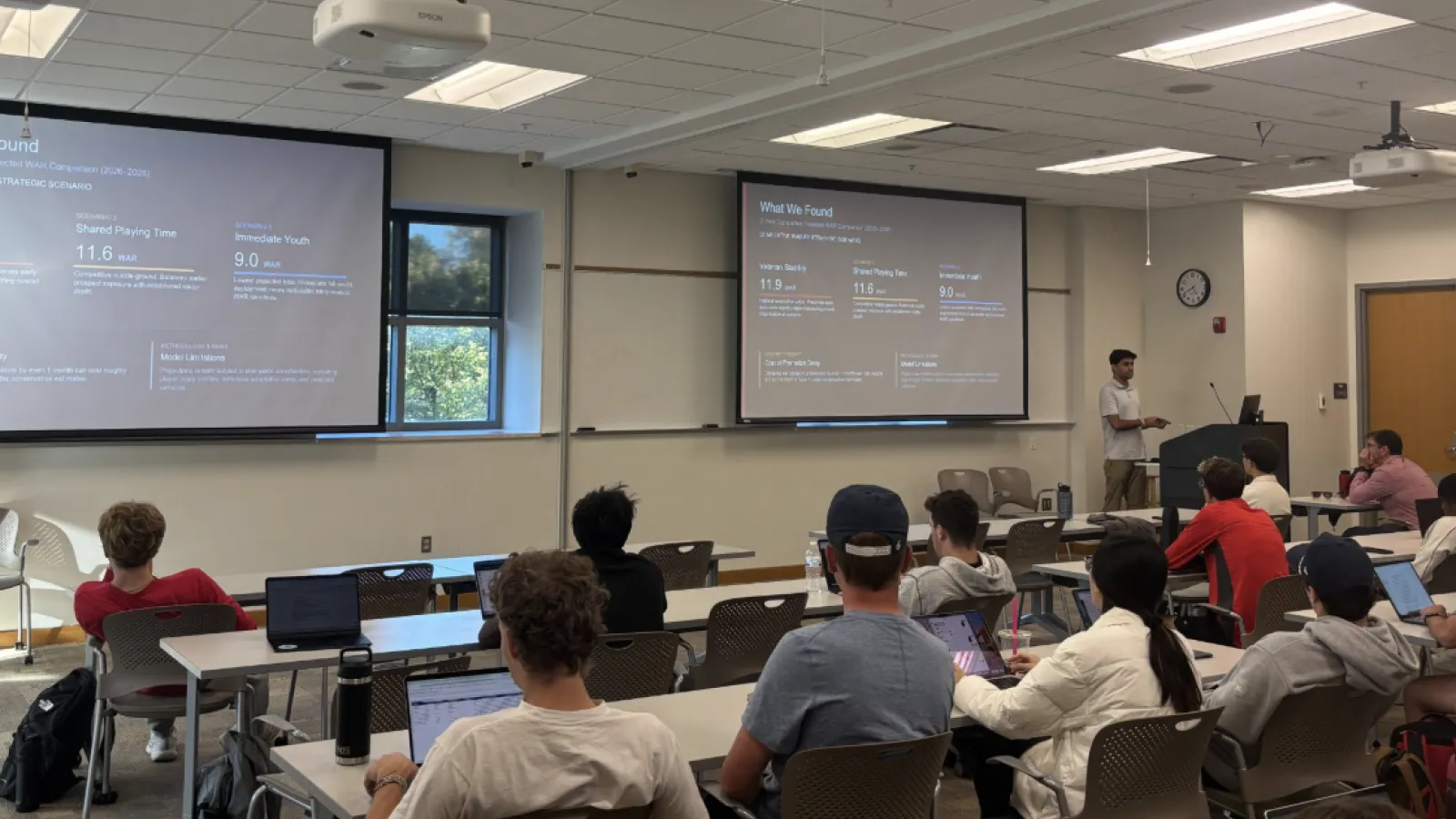
Arihant Aneja, a third-year student in computer science and business analytics, turned his interest in the Cleveland Guardians into a project he presented at the 2026 Sports Analytics Conference.
His project, “Middle-Infield Dilemma for the Cleveland Guardians,” examined how the team should balance playing time between veteran middle infielders and younger prospects.
Aneja and two friends compared three approaches: prioritizing veterans while gradually introducing prospects, giving prospects earlier opportunities while maintaining roster flexibility, and trading veterans early in the season to prioritize prospect development.
“We gathered data, we made our projections, we refined the question by modeling our scenarios, and then turning that into a viable decision framework, as well as a poster,” Aneja said.
The group’s analysis favored prioritizing veterans over immediately shifting to younger players, Aneja said.
“We found that there was a pretty substantial difference between the veteran stabilty approach and the immediate youth approach and again, that didn’t really surprise us, but it just kind of further reinforced the idea that veterans know what they’re doing,” Aneja said.
The event concluded with a question-and-answer session moderated by Ryan Ruddy featuring Sorg, Wang, Aneja and Knoester.
Knoester encouraged students to consider what they want to accomplish through research and explore opportunities to work independently, with other students, with a professor or through a course.
“There's a variety of ways to sort of choose your own adventure,” Knoester said.