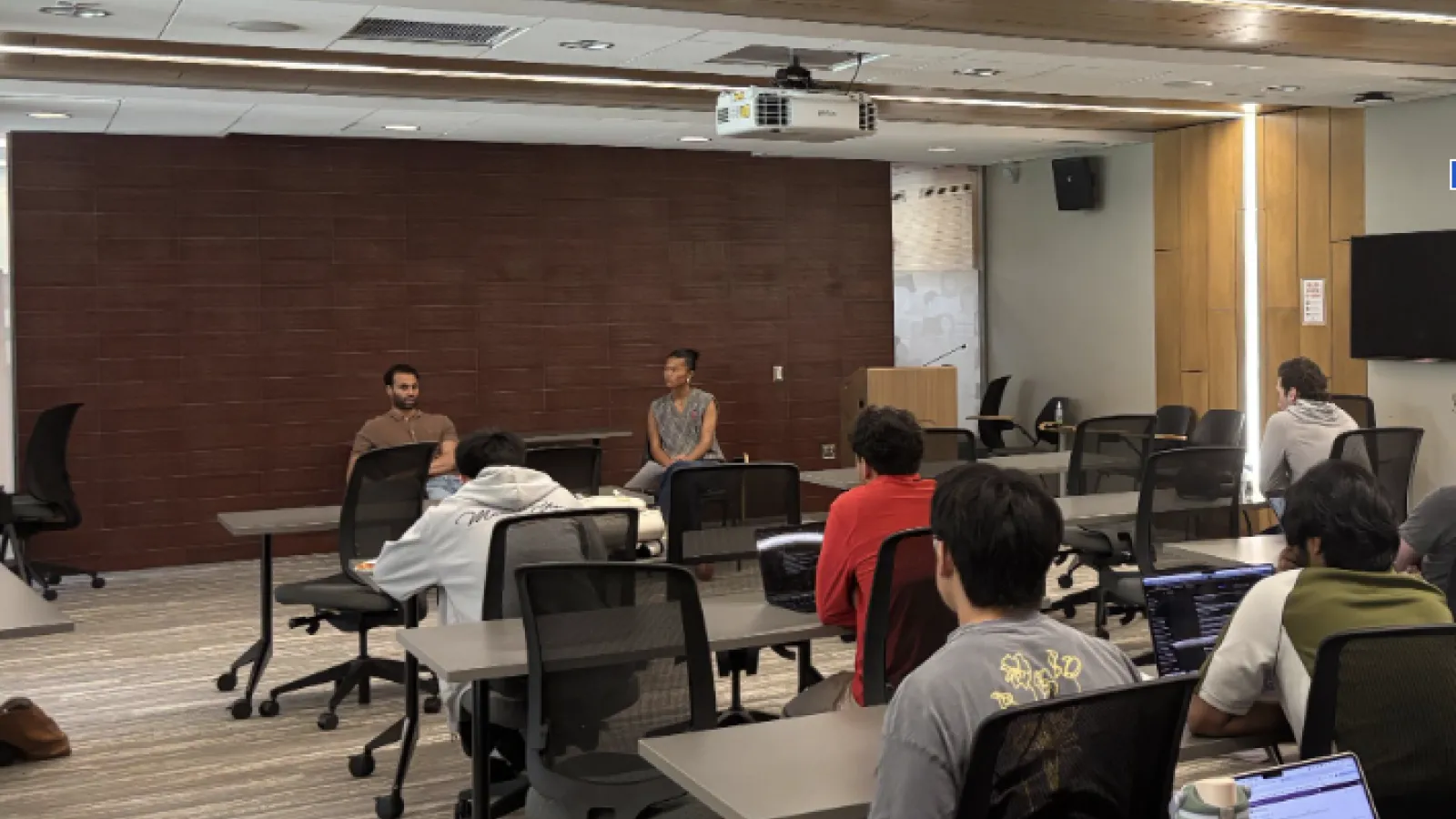
Niraj Shah talks private equity in sports at SSI event
By Reilly Cahill
In an era of college sports shaped by revenue sharing and Name, Image and Likeness, the role of athletic funding has become increasingly important.
Niraj Shah, co-founder and partner at Otro Capital, finalized the first private equity deal in college athletics in December 2025 with the University of Utah.
Shah, who graduated summa cum laude from The Ohio State University with degrees in finance and marketing in 2009, spoke to Ohio State students about his experience investing in and operating sports organizations and how he built a career in private equity.
The role of funding in today’s college athletics
In recent years, changes to college sports such as revenue sharing and NIL have significantly impacted athletic departments, particularly financially.
Shah said schools that have not adapted their athletic financial operations to the evolving landscape are facing growing challenges.
“You put in revenue share and NIL, and now it’s like okay, we’ve got to figure out how to find $20-30 million,” Shah said. “Most athletic departments haven’t figured that out, so they’re just running their athletic departments at a deficit right now.”
With schools facing deficits in athletic revenue, Shah said universities may be forced to pull money from other institutional budgets.
“If you’re losing money, you’re basically just taking that money from the university,” Shah said. “That’s money that should be used for academics, should be used for research. It’s basically just being funneled over and going to pay the quarterback or wide receiver or the offensive line.”
Shah said he believes schools that fail to restructure their athletic finances could eventually be forced to cut sports programs.
“Unfortunately, I just think that the way it’s heading, a lot of universities are just going to continue to fund their athletic departments from the budgets that should be allocated to academics and research, and they’re just going to put their heads in the sand,” Shah said. “I think a lot of other universities are going to end up cutting athletic programs.”
Why the University of Utah partnered with Otro Capital
In December 2025, the University of Utah and Shah’s private equity firm, Otro Capital, agreed to a $500 million partnership.
Shah explained that Otro Capital differentiated itself from other private equity firms by focusing on long-term operational strategy rather than simply providing funding.
“None of them were like, this is how I’m actually going to help you generate more money so that you have enough money to fund what you need to have a competitive team on the field and don’t have to beg donors for money and don’t have to steal money from the university general fund quietly under the radar, which is what every other college is doing right now,” Shah said.
Another reason Otro Capital secured the deal, Shah said, was the company’s detailed 200-page business plan focused on Utah’s fan base, sponsorship opportunities and ticketing strategy rather than simply offering cash.
“Schools need operational help; they don’t need just money to fix the problem,” Shah said. “If you give them just money to fix the problem, they’re going to keep on operating the way they have. They’re going to burn through that money in five years and they’re going to be in the exact same place that they were, except now they just borrowed a ton of money that they owe back, so they’re now in debt.”
How Shah got into private equity
After graduating from Ohio State, Shah began his career in investment banking at Goldman Sachs before eventually transitioning into private equity.
“What attracted me to private equity was in private equity you have to live with those investments and if they go poorly, in theory, you’ve got to live with the consequence of it going poorly and you’ve got the ability to actually do something about it and go in and help fix the company,” Shah said.
Shah said he has spent the last 14 years working in private equity and described how the field differs from investment banking.
“It’s a totally different skill set than just crunching numbers behind a spreadsheet and being on [Microsoft] Excel,” Shah said. “You have to deal with people, you have to hire [people] and you’ve got to figure out what’s the strategy of the company.”